MPG: New insights has been made into accretionary wedges along active plate convergent Margins
文章來源: | 發(fā)布時間:2024-01-12 | 【打印】 【關(guān)閉】
Recently, Mr. Umair Khan, a PhD student of Professor Wu Shiguo and collaborator of the Deep Sea Geophysics and Resources Research Laboratory and University of Science and Technology Beijing published a paper entitled "Middle Miocene renewed subduction of arabian-eurasian plates: Implications for convergent tectonic mechanisms, tectonically-induced fluid overpressures, and sediment recycling dynamics" in the Marine and Petroleum Geology Journal.
In general, accretionary wedges along active plate convergent margins comprise imbricate thrust slices of oceanic crust detached from the downgoing oceanic lithosphere, tectonically-induced fluid overpressures, and wedge-top sedimentary depositional systems. Accretionary wedges have been the subject of extensive research over recent decades due to their significant roles in convergent tectonic mechanisms, sediment recycling dynamics, formation of natural resources, geohazards, and sea-level fluctuations. An observation that has received relatively limited attention is the complex interplay between thrust wedge deformation, tectonically-induced fluid overpressures, and the complex phases of wedge-top sedimentary depositional systems.
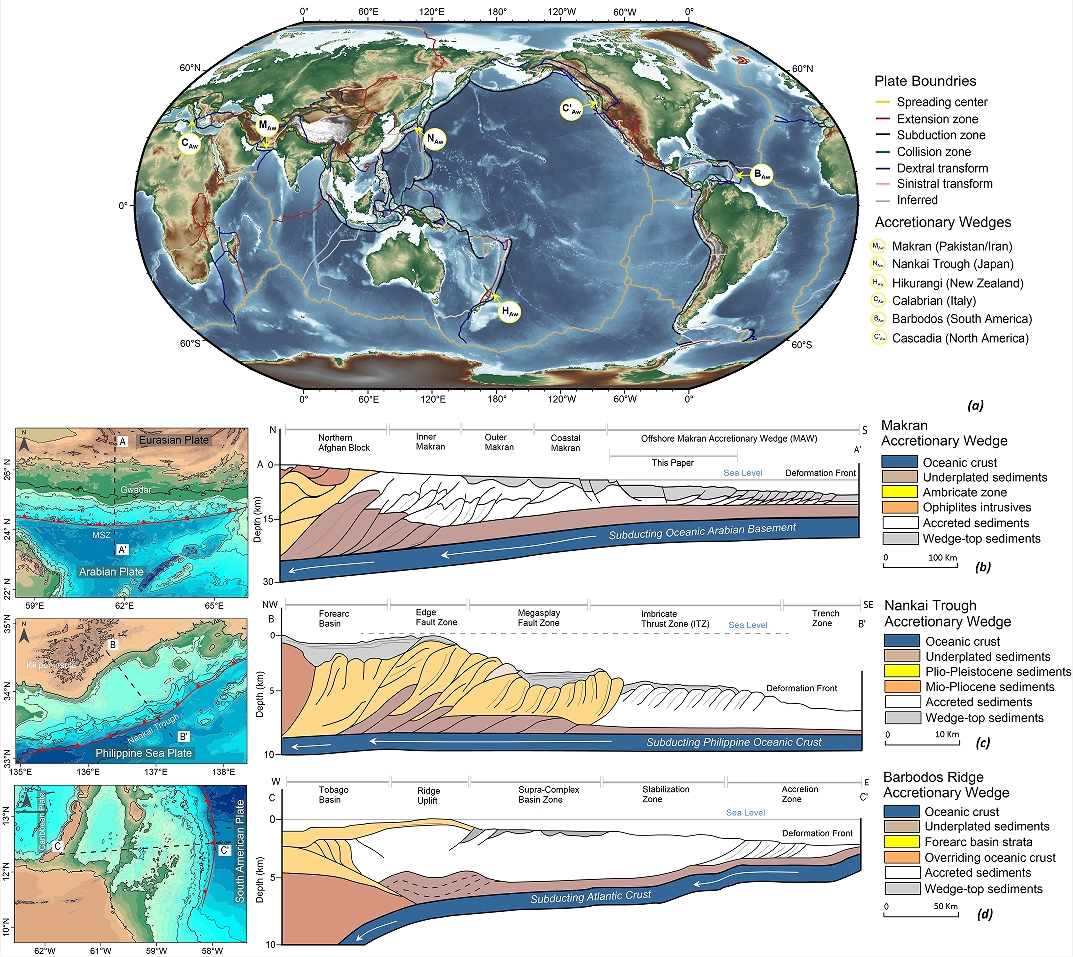
Tectonics plate boundaries, examples of major subduction-driven modern accretionary wedges.
In order to address the above mentioned challenges, the current research focuses on an example from the offshore Makran accretionary wedge (MAW) located in the northern Arabian Sea, where the Arabian oceanic crust obliquely subducts beneath the Eurasian plate. This research employed innovative geological and geophysical constraints derived from seismic stratigraphy, correlation panel of borehole stratigraphy, seismic attributes, depth structural maps, isopach maps, and 3D structural geological models to understand the interplay between (1) the thrust wedge deformational pattern triggered by Middle Miocene renewed subduction of Arabian-Eurassian plates, (2) tectonically-induced fluid overpressure, and (3) deformational pattern of wedge-top syn-kinematic and post-kinematic sedimentary depositional systems of the offshore MAW.
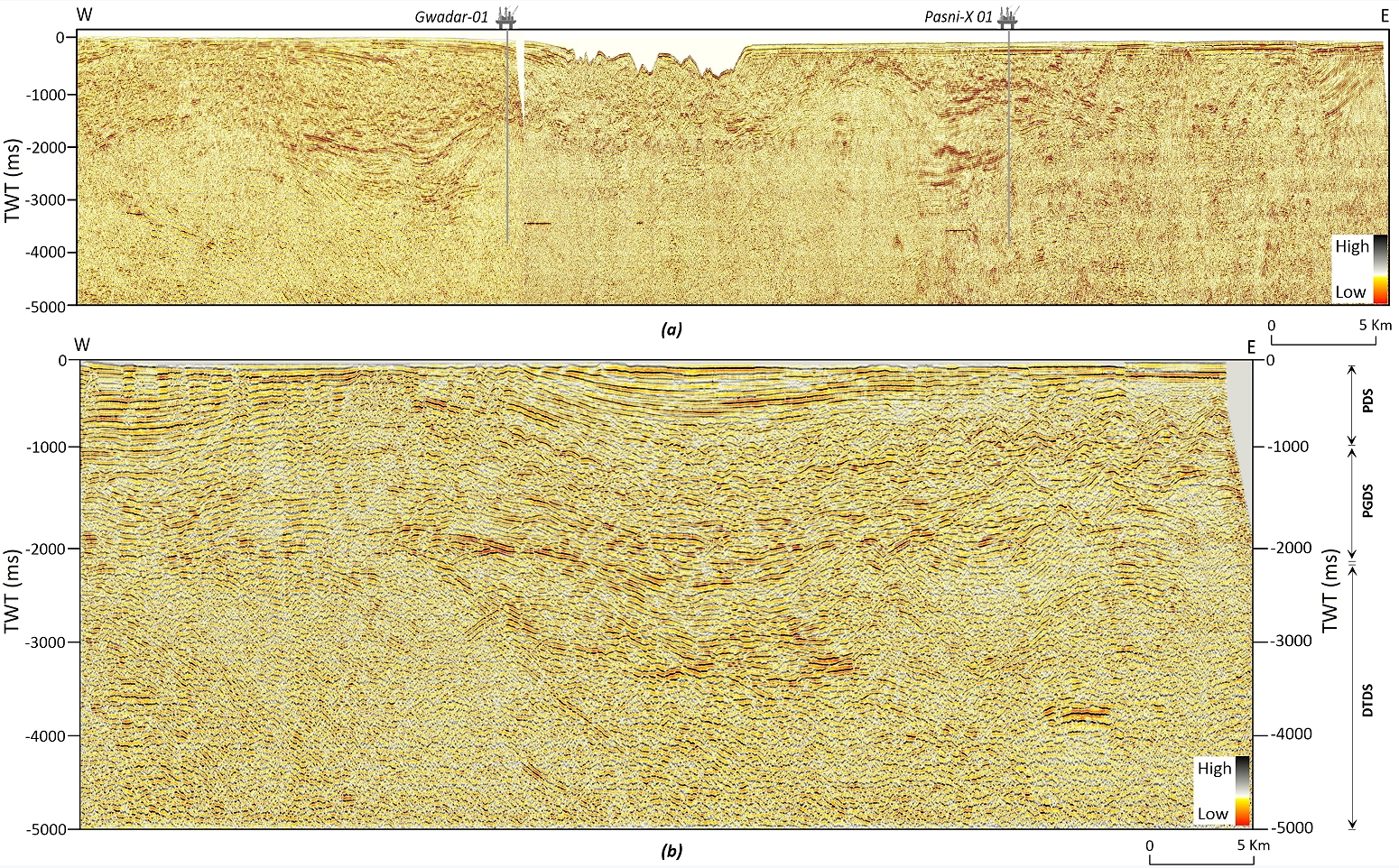
Regional seismic lines (strike) across the Makran accretionary wedge in northern Arabian sea.
The results show that the basement sedimentary successions have been tectonically incorporated into the accretionary wedge by Middle Miocene renewed subduction, which gave rise to complex folding and N-dipping imbricate thrusting features. The N-dipping imbricate thrust faults initiated sediment underplating and acted as structural conduits, facilitating the migration of deep overpressured fluids to fluid escape pipes driven by the underplating sediments. The N-dipping imbricate thrust faults well-developed growth stratal pattern of piggyback basins successions occurs in hanging walls. Piggyback basins carry excellent natural analogues with a rich variety of syn-kinematic filling patterns, growth stratal patterns, onlap terminations onto fault propagation folds, and truncations against growing structures. The post-kinematic sequences are primarily controlled by sea level variations and the high rate of sediment supply from onshore Makran, influencing the preservation and scale of progradational units. Moreover, compared to the Nankai Trough and Cascadia accretionary wedges, the offshore MAW exhibits even greater wedge-top sediment thickness. This discrepancy relates to plate convergence (angle and speed), isostatic responses (uplift and subsidence), surface processes (erosion and sedimentation), and incoming sediment thickness.
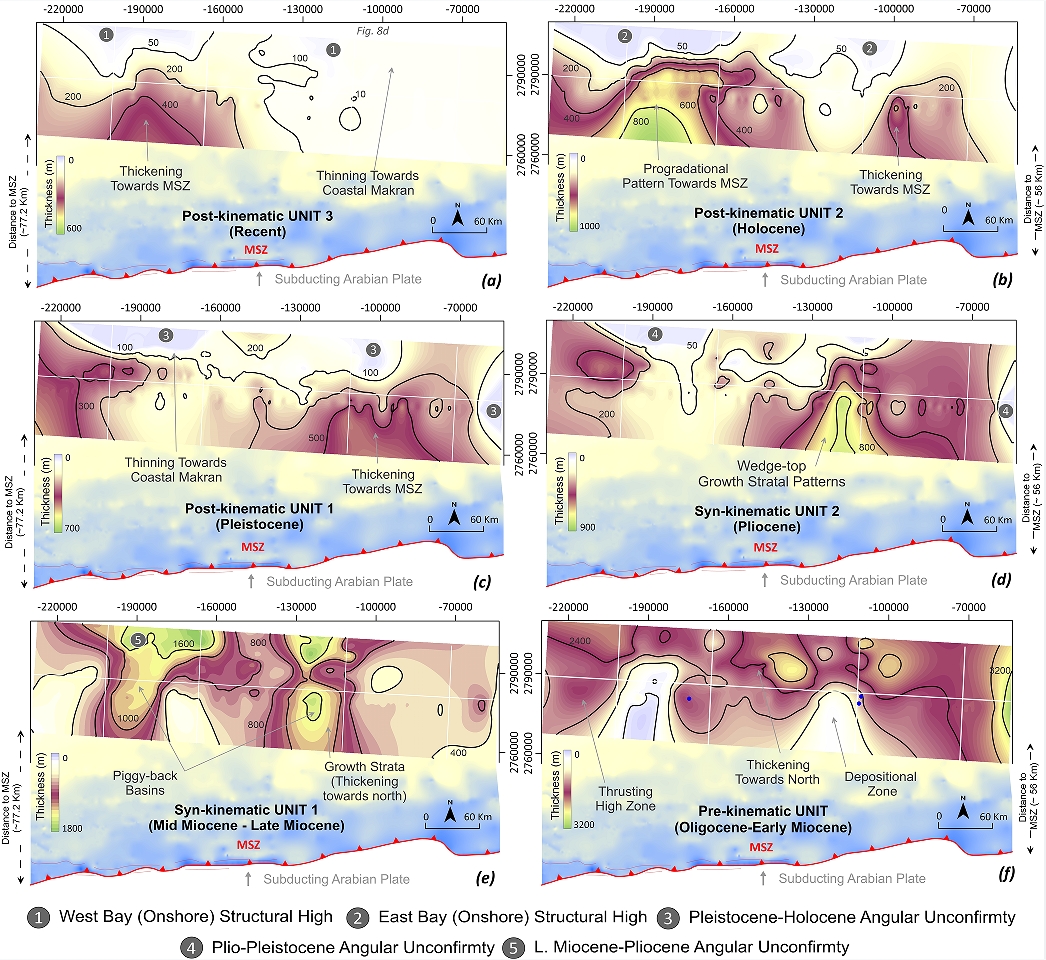
Isopach maps of interpreted stratigraphic units and the location of Makran subduction zone and subducting Arabian oceanic plate show the general distribution and migration of depocenters in time and space.
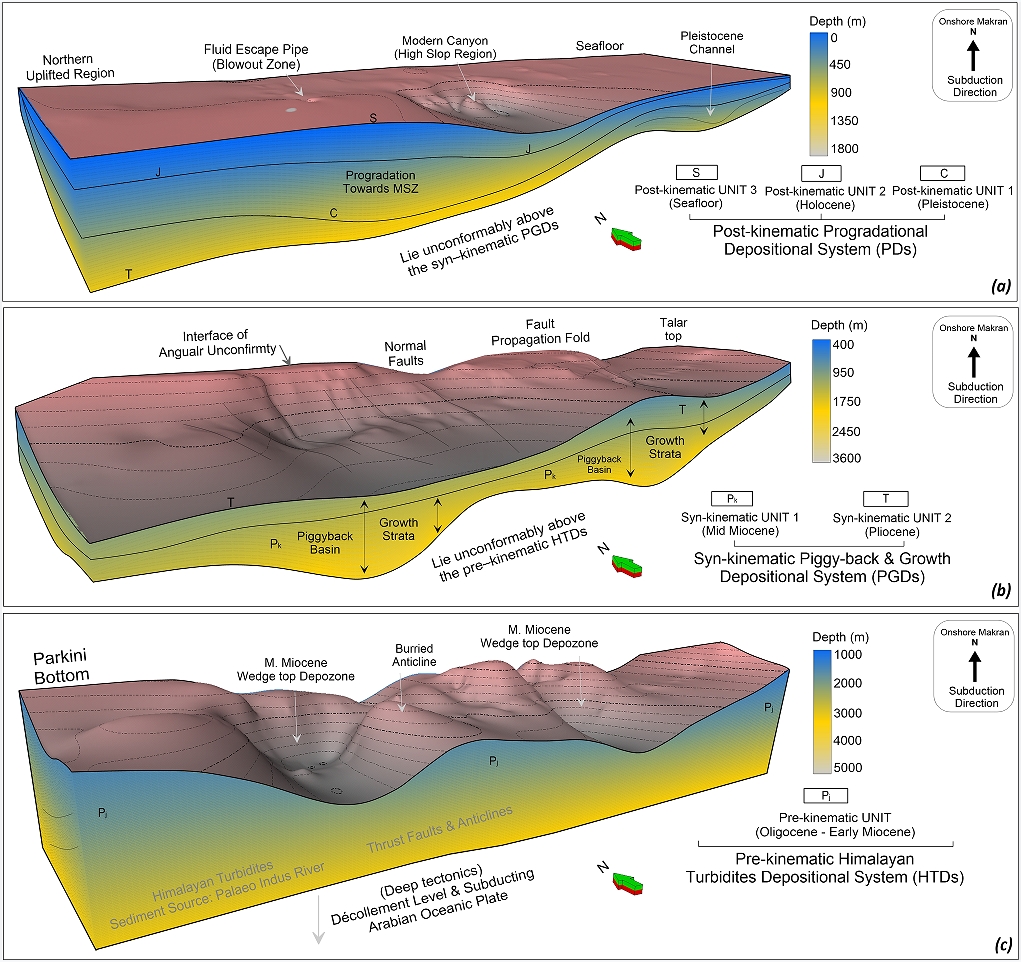
3D solids structural geological models of mega tectono-sedimentary depositional systems.
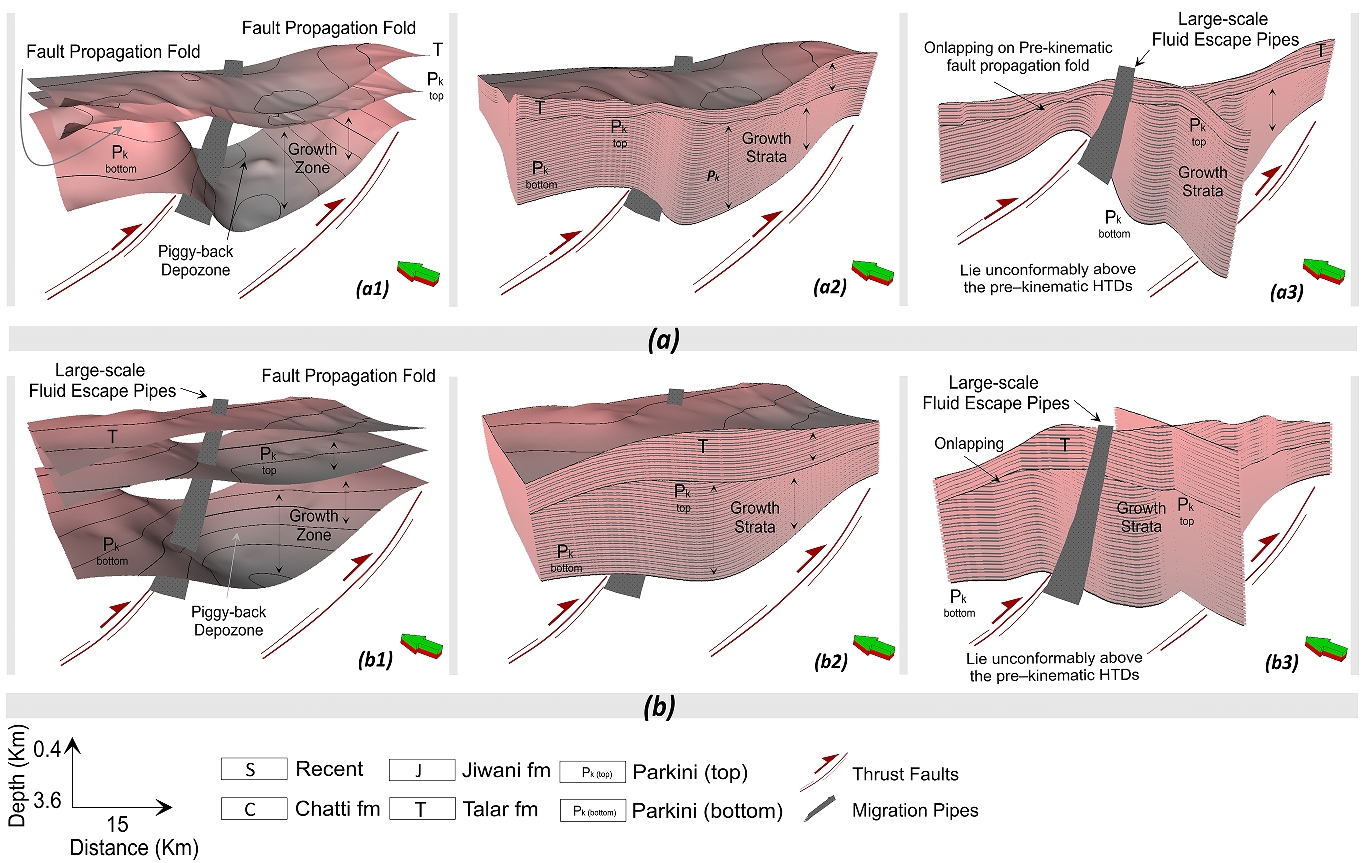
Examples of 3D structural geological models of piggyback basins.
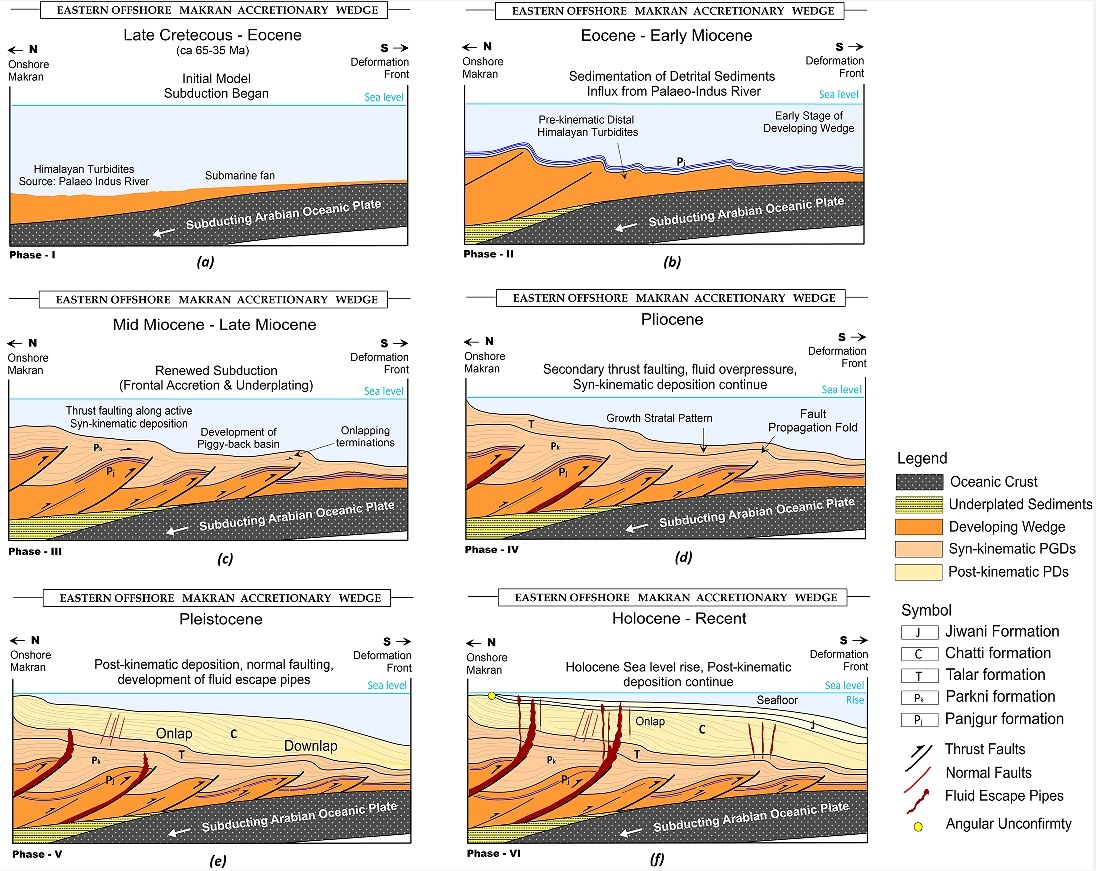
Summarized model specific to Makran accretionary wedge evolution. These illustrate the evolution of inferred deformation of thrust wedge, tectonically-induced fluid overpressure, and deformation pattern of wedge-top sedimentary depositional systems (north to south).
The research was supported by the Innovation Platform for Academicians of Hainan Province (No. YSPTZX202204), and the National Natural Science Foundation of China (No. 92058213).
Paper Information:
Khan, U., Khan, M., Wu, S., Jinwei, G., Middle Miocene renewed subduction of arabian-eurasian plates: Implications for convergent tectonic mechanisms, tectonically-induced fluid overpressures, and sediment recycling dynamics, MPG, 2024, 106704, ISSN 0264-8172.


 瓊公網(wǎng)安備 46020102000014號

